
Education Reform, one more time
March 25: We are halfway through the 2026 legislative session. In the wake of Act 73 and the findings of the Redistricting Task Force that it created to map out drastically fewer school districts, the Legislature is no closer to agreement on next steps.
I supported H.454, which became Act 73, as it developed last year, though I was not able to vote on the final bill due to cancer treatment. I supported it at the time because change is clearly necessary. Few things are more important than our education system. If we are to be competitive with other parts of the country in attracting and retaining young working families, we need excellent schools.
Of course they also need to be affordable. It seems obvious that reducing the number of districts from 119 to a handful would save administrative expense. In the long run, that may be so — though research and testimony cited by the Task Force indicates that savings are likely less than would be expected.
The main drivers of rising costs are elsewhere: health care and insurance, special education, deferred maintenance due to lack of state construction aid, and general inflation, to name a few. Ultimately demographics is our challenge: we have some 25% fewer students than 25 years ago. Rising costs with fewer pupils sends per-pupil cost higher, and that is how spending and taxes are determined.
Furthermore, merging district systems and processes is complicated and brings upfront costs of its own. Most important, it would surely distract staff and teachers from what is really important, which is concentrating on improving the educational experience of our kids.
Education quality probably does benefit from a critical mass of students, as proponents of consolidation and minimum class sizes claim. Certainly a school with, say, a dozen students is not a service to them. But an arbitrary threshold of students per classroom ignores the reality of rural regions like the NEK.
In any case, merging districts and, in extreme cases, closing schools is difficult and often traumatic (recall Act 46 of 2015). Without local buy-in, it is divisive and can be devastating to a community. The Redistricting Task Force recognized this, and, I believe correctly, declined to draw arbitrary district consolidation maps.
Instead, the Task Force report proposed that the quickest way to control costs is not mergers but regionalizing back-office services (such as payroll, purchasing, special-ed contracts, busing, etc.) in Cooperative Education Service Areas. This would achieve a more economic scale for these services.
But the demographic reality is undeniable, and the Task Force did not deny it. Consolidation and even school closures are likely inevitable. But, again, it is far less disruptive for this to occur with local buy-in. The Task Force recommended the State support local leaders as they work with their communities to make the best strategic decisions for their situation.
Lastly, the report also recognized the importance of enhancing educational opportunities for older students through regionalizing high schools where possible.
Governor Scott dismissed the Task Force’s recommendations as “political” and issued an ultimatum to the Legislature: either pass mandatory consolidation with new district maps, or he will veto the State budget.
In my view, the Governor’s threat is the wrong way to achieve policy goals and is an insult to a co-equal branch of government (similar, in fact, to the current President). Frankly, the Governor’s credibility is low and getting lower, considering the persistent shortcomings of the Agency of Education, his re-appointment of an unqualified Secretary last year over rejection by the Senate, and his Administration’s ineffectiveness as educational performance has declined over nearly ten years of his tenure.
I also believe the Governor, and some of my legislative colleagues, are wrong on the policy: forcing top-down, mandatory mergers — Act 46 on steroids — will not work. Restructuring a system that touches every community and nearly every family requires consensus. The Task Force is right: collaboration among local leaders and communities is the only workable path through the wrenching downsizing process ahead.
That path is further complicated by at least two aspects of school choice: maintaining access to schools in sparsely populated rural areas; and threading the needle between the Vermont Constitution’s prohibition against public support for religious schools, and the U.S. Supreme Court’s Carson v. Makin decision requiring that State tuitioning programs include religious schools.
In the NEK, school choice is a lightning-rod issue. Families move here to take advantage of it; suddenly ending it would be unfair to them. On the other hand, their neighbors just across a town line, in a town that operates a public school, don’t have the luxury of choice; and that’s not exactly fair to them. The Town of Kirby (my district) and Riverside School in Lyndonville are Exhibit A of this conundrum.
Some favor universal school choice, for everyone everywhere. But if we truly believe in the value of education as a bedrock of our society and democracy then we must be committed to providing that basic foundation to every child in Vermont. This requires a high-functioning public education system.
Demographics and cost pressures have public education in a vise. School choice, to the extent that it diverts students and funding away from public schools, tightens the screws. That, and appropriately limiting public funding of religious schools, demand that we determine the limits of “choice.”
The limits will not be easy to define, and I am not going to try to do so here. I will say that, as a State Representative for Kirby, I could not support limits that rule out tuitioning to independent schools such as Riverside without a definition of choice that presents a clear and overriding public interest and includes a very long transition, on the order of 15 years. (The case is simpler for secondary schools in our area: the only public high school, Danville, cannot accommodate the students now attending St. Johnsbury Academy and Lyndon Institute.)
Education system reform is necessary, and I support change. But wholesale mandatory district consolidation is not the answer, and it does not appear a majority of the Legislature supports it. The Governor and the Legislature are on a collision course, and I don’t know who will blink.
Last update May 1, 2026
5/1/26: S.325 Bill Summary
The nonpartisan Legislative Joint Fiscal Office issued a bill summary and analysis of the fiscal impact in a Fiscal Note, 5/1/26.
4/14/26: House Environment Committee commits to repeal Tier 3 and Road Rule
Committee consensus is to amend S.325 to repeal — rather than delay — the controversial Tier 3 and Road Rule sections of Act 181. The bill still must be finalized by the committee and approved by the full House and Senate. Committee webpage here.
The Hill on Gov. Scott’s ill-considered return-to-work “fiasco” (4/14/26)
House Ed Bill Up for Vote
4/15/26: House Ways & Means attached its financing work to the Education bill. It goes to the floor on Thursday and Friday, 4/16 & 4/17.
Link to current version (draft 4.2)
Link to Joint Fiscal Office Fiscal Note
Expectations are the bill will pass. From there it goes to the Senate. If the Senate proposes significant changes, most likely the differences will be negotiated in a conference committee.
Share your views
Join me for “coffee hour” once a month on Saturday! All meetings at 8:00 AM:
April 25, Mooselook Diner, Rte 2, Concord
May 16, Kitchen Counter Cafe, new location on Railroad St, St. Johnsbury (across street from old location, in former Kingdom Table)
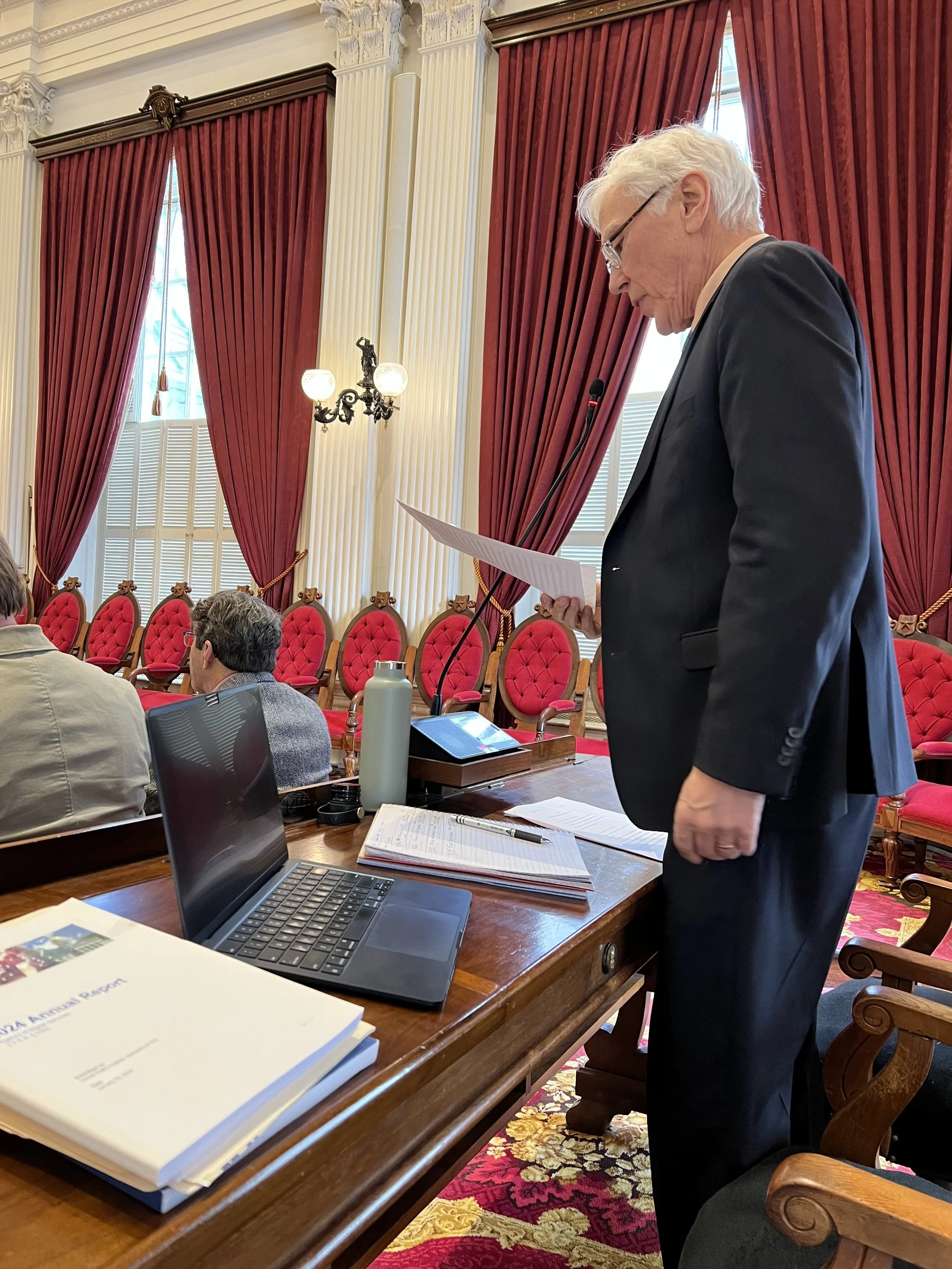
State House Last Lap
At the Legislative Breakfast on March 30 at St. Johnsbury Athenaeum, I announced I will not be seeking another term as your State Representative.
My son and his sweetheart recently announced they are expecting a baby — my first grandchild — this autumn. My wife has decided to leave her work at hospice as well, after more than 15 years. After coping with cancer treatment last summer, it’s time for me to focus on my family. Really!
I am, of course, finishing out my term, which officially ends when a new State Rep is sworn in next January. And I will remain engaged in local issues and possibly board service.
It’s been a great honor and privilege to serve and I thank the voters of St. Johnsbury, Concord and Kirby for their confidence.
Misinformation
A text message blast claiming that I “just voted” for a 7% increase in property taxes, “even though Governor Scott provided a plan that gave homeowners greater relief” was paid for by the VT Republican Party.
It is misinformation. To show why, I have to get into some detail.
The Governor did propose to transfer $105 million from the General Fund to the Education Fund, which would reduce property taxes — this year.
But any “buy down” of the Ed Fund this year creates a gap next year. The larger the buy down this year, the larger the gap next year.
Further, budgets are likely to be even tighter next year, as federal budget chaos (including canceling of previously approved grants, reduced support for state programs and possibly higher inflation due to the President’s war) continues to take its toll.
Yet, property tax increases are a serious problem. Without any buy down, the statewide average property tax increase — emphasize *average* — was estimated to be about 12% this year.
House Ways & Means (the tax committee) proposed splitting the $105 million in two, using $52.5 million (plus $22 million surplus from last year) to reduce property tax this year, and saving $52.5 against the unknowns next year. That brings the average property tax increase to about 7%.
Using the full $105 million, and risking more serious problems next year, would reduce the statewide average property tax increase to about 4%. Again, that’s *average*.
While reducing average tax rates another 3% would be welcome, I still support the Ways & Means proposal as the more fiscally responsible path.
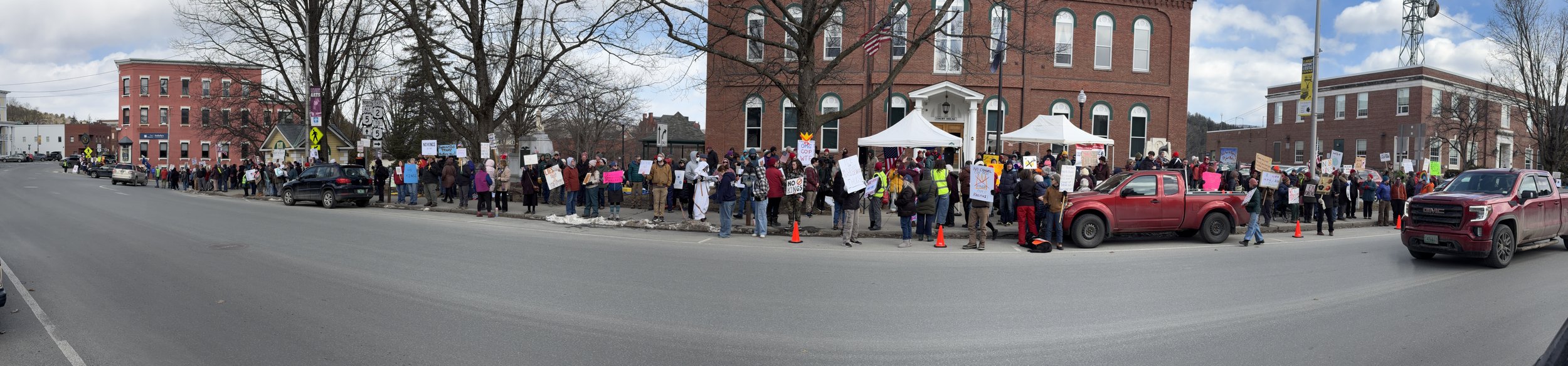

No Kings!, St. Johnsbury, March 28, 2026
Climate Crisis is Not Going Away
Among other ongoing work as a legislator, I am on leadership team of the legislative Climate Solutions Caucus. It’s the largest caucus in the legislature, with over half of the 180 Representatives and Senators.
The climate destabilization now underway due to human activity is a defining challenge of our time.
I am not a climate scientist, but my work over more than 50 years in construction, building design, and energy modeling has made me keenly aware that this is an existential crisis for industrial civilization.
Skyler Perkins is a Vermont documentary videographer and a member of the next generation, which is even more aware of this challenge and how we as a society have failed to confront it.
He is in the process of producing a series explaining how climate disruption, pollution, habitat destruction and biodiversity loss is poisoning the planet’s—and humans’—future.

Event calendar
St. Johnsbury/Concord/Kirby
For help with specific issues, email me at scampbell@leg.state.vt.us.